Friday, March 28, 2008

APRIL!!!


Even though the spring snow is kind of a bummer, come get warm with some seasonal cooking!

With the stress and time strains of exams in mind, The Student Kitchen Project will be hosting three cooking sessions for the month of April*, which means one each week until the end of school!

Drop by for some educational good times, a free dinner, and tons of leftovers to take home, so you can actually forget about cooking for a few days while you try and cram an entire semester's worth of reading into two weeks.

*APRIL 24th Cook-off: For the last few sessions, Bryanna and I have planned the menus beforehand, but April 24th will be a special "cook-off" where we'll organise a little cooking competition of some sort. Details TBA

Thursday, March 27, 2008

March 26th Workshop: MENU - Thai Snapper, Seven-Vegetable Cous Cous, Frittata, Cabbage Salad, Warm Apple Rice Flour Crepes

Tonight's star ingredient: I'm pretty sure is B - The Red Snapper.
(Picture from: Florida Museum of Natural History)


Charlie's Thai Snapper* (Serves 12)
(I don't know who this Charlie is but s/he sure makes a mean fish recipe!)

  • 2 Tbsp. vegetable oil
  • 12 garlic cloves, minced
  • 3 Tbsp. grated fresh ginger
  • 3 small onions, diced
  • 1 Tbsp. red curry paste
  • 2 Tbsp. curry powder
  • 1½ lbs. fresh red snapper fillet, cut into large cubes
  • 1½ cans coconut milk
  • 6 stalks lemon grass, cut into 1-inch pieces
  • 3 red bell peppers, seeded and finely diced
  • salt
In a large frying pan, heat the oil over medium heat. Add the garlic and cook, stirring until golden. Add ginger, onion, curry paste and curry powder. Stir to combine. Place the fish in a single layer in the pan and cook for 2-3 minutes on each side. Add the coconut milk and lemon grass, bring to a boil. Pour the coconut milk over the fish in the pan. Add the peppers and simmer for 5 more minutes. Season to taste.

*Recipe from the Vancouver Community Kitchen Project's cookbook Many Hands: Community Kitchens Share Their Best.


Seven-Vegetable Cous Cous* (Serves 8)
  • 1 lb. carrots, cut into 1-inch pieces
  • 1 lb. parsnips, cut into 1-inch cubes
  • 4 medium onions, peeled and cut into quarters
  • 1 small green cabbage, cored and cut into eights
  • 5 tomatoes, chopped
  • 16 cups of water
  • ½ tsp. turmeric
  • 1 tsp. sweet paprika
  • 1 tsp. ground cumin
  • ½ tsp. cinnamon
  • ¼ cup chopped parsley
  • ¼ cup chopped cilantro
  • 1 lb. zucchini, cut into 1-inch pieces
  • ½ lb. sweet potatoes, peeled and cut into 1-inch strips
  • 2 red peppers, seeded and cut into 1-inch strips
  • salt, pepper, and cayenne pepper to tast
  • 1 19 oz. can of chickpeas, drained and rinsed
  • 4 cups cous cous
  • 2 Tbsp. olive or vegetable oil
  • 4 cups boiling water
  • lemon wedges
In a large pot, combine the carrots, turnips, onions, cabbage, tomatoes, water, tumeric, sweet paprika, cumin, cinnamon, parsley, and cilantro. Bring to a boil, reduce to a simmer and cook for 10 minutes. Add the zucchini, sweet potatoes, red peppers, salt, pepper, cayenne, and chickpeas. Simmer until the vegetables are tender, 15-20 minutes.

While the vegetables are cooking, work the oil into the cous cous with your fingertips. Stir in the boiling water and cover tightly. Let stand until tender, 15-20 minutes.

Fluff up the cous cous and serve with the vegetable stew and lemon wedges.

*Recipe from the Vancouver Community Kitchen Project's cookbook Many Hands: Community Kitchens Share Their Best.


"Hakuna Frittata" (Mixed Vegetables and Feta Frittata)
On the 26th, the recipe was x3 to serve 12
  • 2 tsp olive oil
  • ½ cup diced red onions
  • 1 tsp minced garlic
  • ½ cup each diced red bell pepper, thinly sliced zucchini, and chopped mushrooms
  • 1 Tbsp. minced fresh oregano leaves, or 1 tsp dried
  • 1½ tsp minced fresh thyme, or ½ tsp dried
  • 8 whole eggs, lightly beaten
  • Salt and freshly ground black pepper to taste
  • ½ cup crumbled light feta cheese (2 oz/57 g)
1) Heat olive oil over medium heat in a 10-inch, non-stick skillet. Add onions and garlic. Cook
and stir until onions begin to soften, about 2 minutes. Add red pepper, zucchini, and
mushrooms. Cook and stir until vegetables are tender, about 5 more minutes. Stir in oregano
and thyme. Cook for 30 more seconds.

2) Reduce heat to low. Pour eggs over vegetables, making sure that vegetables are evenly
distributed in skillet. Sprinkle with salt and pepper. Sprinkle feta cheese evenly over egg
mixture.

3) Cover skillet with a tight-fitting lid and let cook until eggs are completely set, about 12
minutes. Slice into 4 servings and serve hot.


Thai Red Cabbage Slaw (Serves 12)*
  • 2 lbs. red cabbage, cored and finely shredded
  • 1 cup coarsely chopped mint
  • 1 cup coarsely chopped cilantro
  • 8 greens onions, thinly sliced
  • 4 cloves garlic
  • 6 Tbsp. lemon juice
  • 1 Tbsp sugar
  • 1 tsp salt
  • 1 tsp pepper
  • ¼ cup fish sauce
  • ½ cup vegetable oil
  • 1 cup coarsely chopped peanuts
  • ½ cup sesame seeds, toasted
Combined the cabbage, mint, cilantro and green onion. Stir the garlic, lemon juice, sugar, salt, pepper and fish sauce together. Slowly beat in the oil. Pour over the cabbage mixture and toss well. Toss in the peanuts and sesame seeds just before serving.

*Recipe from the Vancouver Community Kitchen Project's cookbook Many Hands: Community Kitchens Share Their Best.


Warm Apple Rice Flour Crepes (Serves 12)*

Apple filling:
  • 10 braeburn apples, cored, peeled, and chopped
  • Cinnamon
Warm apples with cinnamon in a sauce pan over medium heat with some water. Let boil and reduce heat to low and let simmer until apples are soft enough to mash.

Crepes:
  • 2 cups milk
  • 4 eggs
  • 4 Tbsp melted butter
  • 1 cup rice flour
  • 2 Tbsp cane sugar
  • pinch of salt
  • Serve with vanilla yogurt or soyogurt
Mix dry ingredients together. In separate bowl, whisk eggs, milk and melted butter. Then, whisk into dry ingredients. Heat crepe pan over medium heat. Use 1/3 cup batter per crepe. Cook for 2 minutes per side. Remove from pan and set on a plate. Separate crepes with parchment or wax paper to prevent sticking. Crepes can be prepared up to this point and stored in the fridge for up to 3 days or the freezer for up to a month.

*This recipe is a variation of the one found at 5 to 10 a day - Recipes - Warm Apple Crepes

Wednesday, March 26, 2008

Attack of Soyzilla: The Eco-conscious Vegetarian's Dilemma

Incredible, unstoppable titan of terror!
(Picture from: Agriculture and Agri-Food Canada - where you
will also find an article about the "economic magic" of soy).


Upon reading my blog entry, undoubtedly the one about meat-eating, a friend of mine sent me a link to a very interesting clip from a special report called Argentine: Le soja de la faim that was shown on the French/German channel ARTE. The report is about GMO soy production in Argentina, the role of agri-giant Monsanto, and the looming social and ecological disaster it is becoming for the country. Coincidentally, the issue of the environmental impact of soy production was also a topic brought up at the dinner table tonight.

To be fairly Canadian, here is a link to an English language article by Marcela Valente, from Inter Press Service News Agency, on roughly the same subject:
AGRICULTURE-ARGENTINA: Soy Overruns Everything in Its Path.

In most produce stores one can find tofu and soy milk, and in the stores that service the more conscious eating crowd, one can find some of the novel products from whom I like to call "the soy engineers" like: soy cheese, soy dogs, soy burgers, soyogurt, soy gelato, and soy "ground meat." Diversity should be the golden rule to any diet but eating too much soy seems clearly like a bad idea - even if it is in a diversity of shapes, textures, and consistencies. I was in a vegetarian food store once and saw that I could buy soy moulded into a whole fish shape, or "beef slices".

Soy is a favourite and easy alternative to meat for vegetarians and healthy eating fans. I know that it was the first thing I found myself consuming more often when I started laying off the meat. I still hit the soy milk pretty hard, however, soy is also used for other purposes such as bio-fuel. Perhaps this is why it has become a major cash crop, and one of the causes of deforestation in parts of the world, including the Amazon, to pave the way for massive farms. The agricultural commodities market is also overrun with GMO soy. This means that sometimes, even if one's intentions are well-meaning to start, without informed decision-making, one could still potentially end up where s/he started.

So far, from what I've gathered through conversations with my nutritionist, happy vegetarians, and knowledgeable eaters, and through books and my travels on the interweb, some good alternatives to soy are legumes such as chickpeas and other beans such as kidney beans, red beans (adzuki beans), navy beans... Also, try to incorporate into meals lentils, or grains such as quinoa, millet, barley, or sorghum, to name a few.


Sincerely,
your colleague in trying to make more thoughtful choices,
-Bonnie

Tuesday, March 11, 2008

Wednesday Dinners at West Point Grey United Church

I was actively recruiting classmates today for cooking sessions when my professor mentioned that he helps out on Wednesday nights at West Point Grey United Church - at 8th and Tolmie - for their free dinners.
The 3-course dinners run every Wednesday from 6-8pm (contact for more details), from Thanksgiving to Easter, and are open to everyone.

Please send us anything you might know of, and we will also continue posting any happenings we hear of around the city that offer to make stomachs a little fuller.

Monday, March 10, 2008

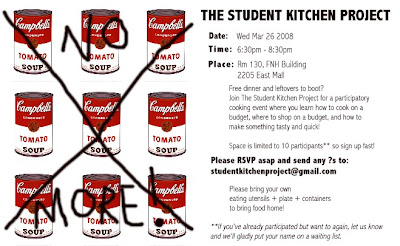
March 26th

Come out!
Don't be afraid, it's only posturing for our posters.
We're not condemning canned goods.
We're friendly.
Radicals are what we mostly put in soups and salads!

Saturday, March 8, 2008

The Calculated Impact of Meat Consumption

During my perusals on the interweb to try and learn more about eating meat in season, I came across this neat little "Food miles rater," by a Vancouver Island-based non-profit organization called LifeCycles Project, that tabulates the environmental impact of your different meat choices.

An Open Letter: To Meat or Not to Meat?

What would Clooney do?
(Picture from FreeFoto.com)

Dear Universe,

I'm not a vegetarian (dang sushi!) but I don't eat a whole lot of meat, and rarely ever when I'm cooking for myself. However, for the Student Kitchen Workshop in February, we incorporated 1½ dishes with meat - and the other 1½ were veggie-friendly.

I'm not really sure if there was any real reasoning behind having the meat dishes, other than the fact that they tasted pretty good. While planning this next menu, I had thought to include a pork dish but after thinking about it, and discussing with Bryanna, I realised that I wasn't really confident about my initial reasoning for incorporating meats.

My desire to incorporate meats stemmed from a desire to appeal to as broad a potential participant group as possible: To reach people who make frequent food choices based on convenience - which includes fast-food, and/or ready-made dishes, bought at the supermarket, at food courts, or of the microwaveable and/or canned variety - and usually with some sort of meat in it.

While protein can be found in many other sources, I know that sometimes people just simply LOVE meat, and fear vegetarian dishes to be something like "hippie food." However, one of the goals of the Student Kitchen Project is to help students acquire cooking knowledge on a budget, but we also want to stress the necessity of more eco-conscious eating, which is something that we, as those who will inherit the earth, need to ponder more. Meat eating is an expensive, unsustainable, and exploitative endeavour, and its production and consumption have, and will continue to have, tremendous impacts on the earth and its living.

We live in a world of conflicting ideals, but in order to keep to our ideals, compromises need to be made. Thus, The Student Kitchen Project will plan for all vegetarian-friendly dishes, but have a utilitarian option to incorporate a meat dish to interested persons. In the end, it really is about thoughtful choices.

xo!
-Bonnie